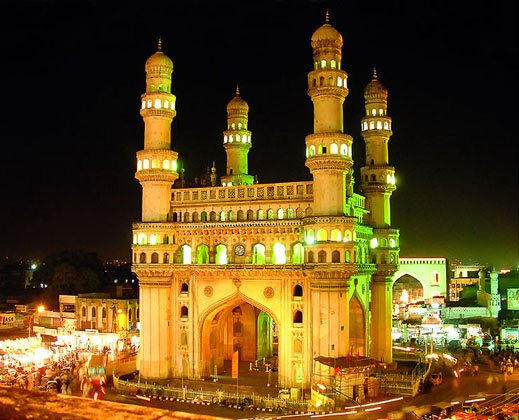
| Hyderabad - a cosmopolitan capital city - Nalamotu Chakravarthy |
When Sri Krishnadeva Raya took to the Vijayanagara throne in 1509, the empire was in a significantly weakened state. The entire coastal Telugu areas were occupied by Orissa. Similarly, the Kannada and Tamil regions have also raised a flag of revolt. 24 year old Sri Krishna Deva Raya was determined to put things in order. He first invaded Mysore (Srirangapatnam) and suppressed the Kannada revolt. He then marched on coastal Telugu region and drove out the Orissa army from Udayagiri, Kondavidu, Kondapalli, and Rajahmundry. After this Krishnadeva Raya marched on Tamil Coromandel coast and subdued that region as well. At the end of these battles, that lasted six long years, he was able to bring back the entire South India under Vijayanagaram’s suzerainty.
While Sri Krishnadeva Raya was busy consolidating his empire, Bahamani Empire of Deccan (Gulbarga) was going through infighting. Sultan Quli, who came to India from Turkey, raised a flag of revolt against Bahamani. He attacked Devarakonda and ended the Velama kingdom’s rule.
 Learning of the attack on the Velama kingdom, Sri Krishna Deva Raya rushed with his forces to rescue and camped at Panagal in Nalgonda. In a fierce battle that ensued, Sultan Quli defeated Sri Krishna Deva Raya forcing his retreat from Nalgonda. Encouraged by his victory, Sultan Quli marched on Coastal Telugu districts. Sri Krishnadeva Raya learnt his lesson and moved into Coastal Andhra with a massive army and succeeded in driving out Sultan Quli’s forces. As a result, today’s Nizam region was separated from Telugu land and a tenuous peace reigned between Vijayanagaram and Qutub Shah who started ruling from Golkonda.
Sultan Quli’s brother Ibrahim was the assumed heir to the Golkonda throne. Ibrahim got into a dispute with his brother. Vijayanagaram, after the premature death of Sri Krishnaceva Raya, was now under the rule of his son-in-law Aliya Rama. Aliya gave a large estate in Vijayanagaram to Ibrahim and provided protection from his brother. After the demise of Sultan Quli, Ibrahim left Vijayanagaram and went on to become the king of Golkonda.
Ibrahim, after the fall of the Vijayanagara Empire, started annexing its Telugu districts. In 1571-72 he captured Rajahmundry, in 1579 he captured Vinukonda, Kondavidu, Kacharlakota, and Khammam.
Hyderabad city was not founded at this time. After Ibrahim Quli’s death, his son Mohammed Quli continued consolidating his hold on Vijayanagara Telugu regions. Mohammed occupied Kurnool, Cuddapah, Nandial, Dole, Gandikota, and Nellore.
Mohammed Quli Qutub Shah completed the consolidation of the Telugu region under Muslim rule. He founded Hyderabad in 1589. At the time of the city’s founding the entire Telugu country, including the current Nizam, Circar, and Ceded regions, was under Qutub Shahis.
Moghul Emperor Aurangazeb intended to consolidate his hold on South India. He attacked Golkonda and captured it in 1687, thus ending the
Qutub Shahi rule. He appointed his representative Nizam to administer the Golkonda kingdom.
British entered India in 1600 to conduct trade through the East India Company. Inspired by the stupendous financial success of the East India Company, French entered Indian shores in 1650s through the French East India Company. The British and the French quickly went beyond their original goal of trade and got involved in regional conflicts between Indian kingdoms. British were the best in the world when it came to using gun powder, followed by the French.
Nizam Asaf Jah of Hyderabad declared independence from Delhi in 1720. Asaf Jah died in 1748. His sons got into a fight for the Hyderabad throne. British and French sided with different heirs in that power struggle. Both the British and the French had their eyes set on the Coastal Telugu districts for maritime trade and military reasons.
The French helped Nizam’s third son Salabat to capture the Hyderabad throne. In return for their generosity, Salabat assigned Coastal districts to the French. The British, concerned with the growing French influence, under the leadership of Colonel Clive, marched on the Coastal districts in 1759 and occupied the region. As a result, the British were officially at war with the Hyderabad State.
 Seven years later in 1766, the British and Nizam reached an agreement to end hostilities. In return for keeping the Coastal districts, British agreed to pay nine lakh rupees a year to Nizam. As you can see, though Coastal districts were separated from the rest of the Telugu land, the districts were still contributing to Hyderabad exchequer through the taxes paid to the British, which are in turn being passed on to Nizam.
The conflict between the British and French continued in the Indian subcontinent. Nizam once again sided with French and invited 15,000 French soldiers to protect Hyderabad. British marched on Hyderabad and drove out the French soldiers. Nizam was forced to accept British protection through a treaty signed in 1798. As a result, six battalions of British forces were placed in Hyderabad. Nizam was required to pay 24 lakh rupees a year for the maintenance of British troops.
Nizam could not pay the British these monies and as a result amassed a significant debt. In 1800 he was forced to cede Bellary and Cuddapah to the British in return for the British military expense.
So, it is clear that Hyderabad continued to receive British protection with the taxes paid by the Circar and Ceded districts even after these regions separated from the Hyderabad State.
Hyderabad State, in addition to the 8 Telugu districts, had 4 Kannada and 3 Maratha districts. There was an atrocious tax regime under Nizam. Peasants of all these districts paid taxes through their nose to Nizam.
Today’s Hyderabad city is a source of revenue for the rest of the State. However, prior to 1956, the situation was quite different. The rural areas of the Hyderabad State financed the expenses required to maintain the capital city.
Now, with that background, who can stake a claim for Hyderabad city?
Our capital city belongs to the people living in erstwhile Nizam Telangana, Maratha, and Kannada districts- particularly the peasants. It belongs to Hyderabadi Muslims including those that came from Iran, Iraq, Turkey and other places. It belongs to the Marathis, Kannadigas, Marwadis, Rajputs, Gujaratis, Punjabis and many others who have been living in Hyderabad city for many generations.
Lastly, it belongs to the people of the Circar and Ceded districts. As separatists call them, these people are not “settlers” but are rightful stakeholders of the Hyderabad city. Just like the poor peasants of the Nizam districts, their forefathers have also contributed to the development of Hyderabad city by paying taxes to the Qutub Shahis, the Nizams and the British.
* * *
Slightly edited; emphases ours - IMS.